Hi everyone! at Little Roots Dental Studio, I, Dr. Aastha Jha evaluate how everyday life and health interact, and I’ve witnessed a lot of dental trends come and go. However, the science of maintaining healthy teeth is still a fundamental aspect of modern dentistry.
Today, we’re looking into a subject that is just as significant for a 60-year-old retaining their last teeth as it is for a 6-year-old losing their first: Fluoride and preventive dental treatments.
Whether you’re an adult trying to prevent another filling or a parent wanting to safeguard your child’s new “grown-up” teeth, knowing the “how” and “why” of dental care can save you a lot of time in the dentist’s office.
What is Fluoride, and Why Does it Matter?
In its most basic form, fluoride is a mineral that occurs naturally in water, soil, and even some foods. It is sometimes referred to in the dental field as “Nature’s Cavity Fighter.” However, how does it really operate?
The Strengthening Science
The hard outer covering of our teeth, known as tooth enamel, is composed of hydroxyapatite, a crystal. Demineralization is the process by which the acid produced by oral bacteria breaks down these crystals when we consume sweet or starchy foods like,(potatoes, rice, bread, pasta, and cereals).
According to scholarly research published in journals like MDPI Healthcare, fluoride works in three main ways:
- Remineralization: It helps “rebuild” damaged enamel before a cavity may completely develop.
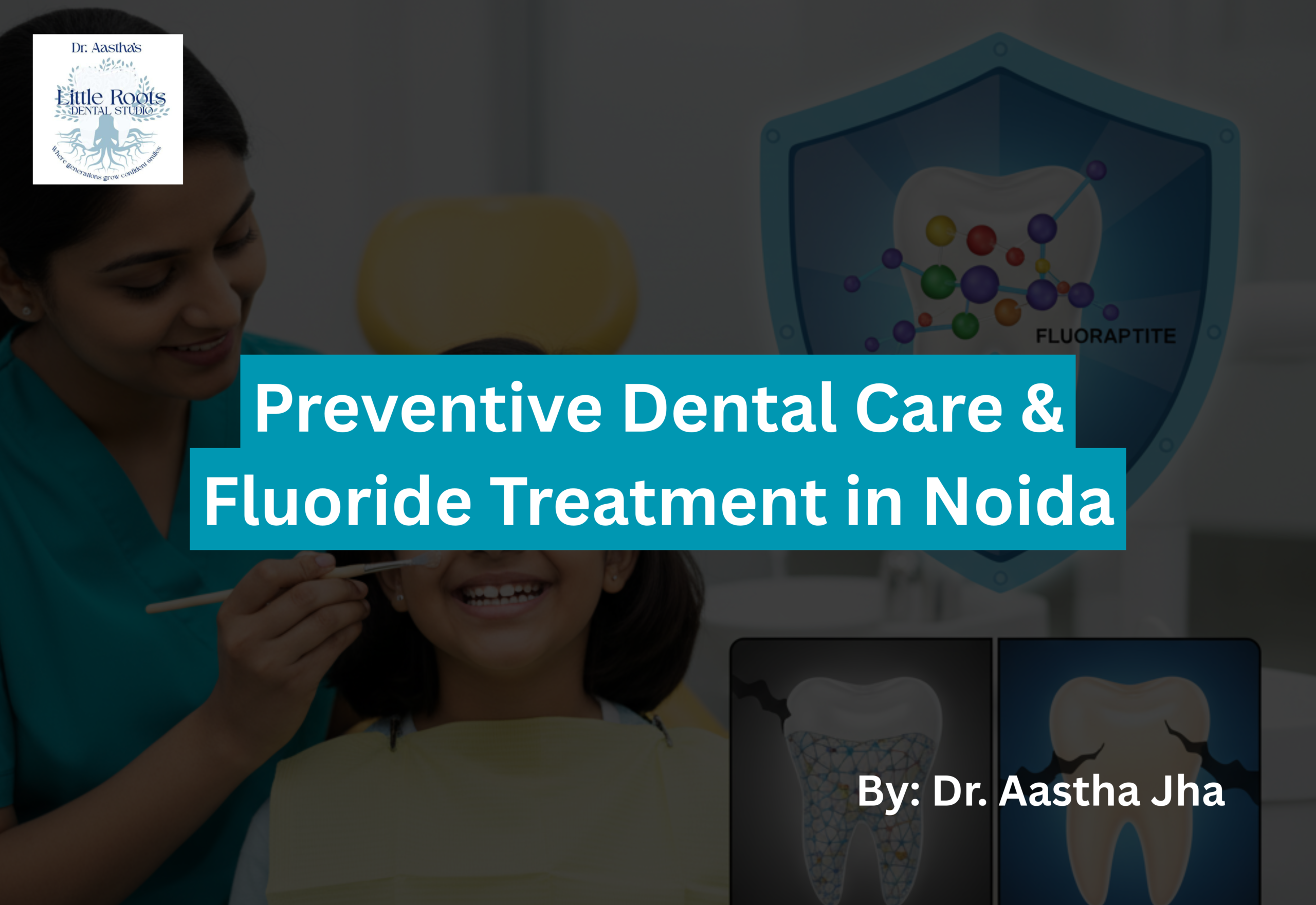
- Acid Resistance: Fluoride forms fluorapatite in your teeth by switching places with certain molecules. Compared to the old enamel, this new structure is significantly more resilient and acid-resistant.
- Bacterial Interference: Fluoride actually hinders the production of the decay-causing acid by the “bad” bacteria in your mouth.
At Little Roots Dental Studio: Our Approach to Cavity Prevention
We customize fluoride, not just “apply” it. Our professional establish the precise concentration of fluoride varnish required by evaluating your child’s unique enamel density and eating habits. We make sure the procedure is enjoyable rather than tedious by utilizing premium, flavored varnishes.
Preventive Super-Tools: Sealants, APF and Enameloplasty
Certain areas of our teeth require additional assistance, even if fluoride is an excellent general defender. Your back teeth have deep pits and grooves. These resemble “canyons” where food becomes lodged and toothbrushes are unable to access it, like a narrow, deep valley.
1. Sealants for pits and fissures
Consider a sealant to be your tooth’s little plastic raincoat. According to academic data from StatPearls, sealants can lower molar decay risk by about 80% within the first two years of administration.
- How it works?
On the chewing surfaces of the back teeth, a dentist “paints” a thin layer of resin. It produces a smooth, brushable surface that hardens rapidly.
- Who needs it?
They are typically given to children between the ages of 6 and 12, when their permanent molars erupt, but they can also help adults who are at high risk of cavities, due to deep grooves on molars.
2. The “Smoothing” technique, or enameloplasty
In enameloplasty, sometimes referred to as odontoplasty or tooth reshaping, a dentist removes or reshapes a small portion of tooth enamel in a rapid, painless, and non-invasive cosmetic dental operation. It is used to improve the bite, symmetry, and overall appearance of the smile by fixing minor flaws such small chips, uneven edges, or pointed teeth.
Sometimes a sealant cannot adequately settle in a tooth because of deep or irregularly formed grooves. Enameloplasty, also known as the Enameloplasty Sealant Technique is used in this situation.
At Little Roots Dental Studio: Our Approach to Cavity Prevention
Our top goal is accuracy. During an enameloplasty, we carefully smooth such deep “valleys” in the teeth using tiny instruments without removing a lot of enamel. This gives our sealants the ideal “grip” and keeps them in place for years as opposed to just a few months.
India’s Fluoride Policy: A Fair Perspective
Fluoride is a bit of a “Goldilocks” story in India—we need it just right. Due to India’s distinct geographical characteristics, people’s exposure to fluoride might differ greatly depending on where they live.
The Data You Must Understand
The Indian population is exhibiting an intriguing pattern, according to recent academic evaluations, including meta-analyses from 2024 and 2025:
| Category | High Fluoride Areas (India) | Normal Fluoride Areas (India) |
| Caries (Cavity) Prevalence | ~39.5% | ~48.2% |
| Dental Fluorosis Risk | High (~59%) | Low (~39%) |
| Protective Benefit | Stronger enamel | Standard protection |
Although fluoride greatly reduces the incidence of cavities (caries) in India, dental fluorosis can result from excessive fluoride in groundwater, which is widespread in areas like Rajasthan, Gujarat, and Andhra Pradesh, according to research published in the Indian Journal of Medical Research. Because of too much fluoride throughout childhood, this disorder causes white or brown spots to appear on the teeth.
At Little Roots Dental Studio: How We Help You Fight Cavities
We are aware of the local environment. To help Indian families regulate their fluoride intake, we offer customized consultations. We provide cosmetic alternatives and “low-fluoride” preventive measures that prevent cavities without exacerbating spots if your child exhibits mild fluorosis.
Professional Fluoride Applications
It is our recommendation at Little Roots Dental Studio that both adults and children receive a professional “Fluoride Application.” The toothpaste you use at home is not the same as this.
Fluoride Varnish: A highly concentrated “sticky” gel that is applied to teeth. It provides a significant “recharge” of minerals to the enamel over the course of many hours.
Fluoride Trays: Fluoride trays are frequently referred to as a “mineral bath” for the teeth at Little Roots Dental Studio. Adults with dry mouth or those kids receiving orthodontic treatment (braces), where the risk of decay is increased, are frequently treated with fluoride trays.
Varnishes work well for fast applications, but trays provide a consistent, high-concentration soak that covers the entire tooth surface from all sides.
Summary Checklist for Your Family
- Check Your Water: Find out if the fluoride levels in your Indian neighborhood are high.
- Use a pea-sized amount of fluoridated toothpaste when brushing twice a day.
- Inquire about sealants, particularly for kids aged 6 to 14.
- Frequent Checkups: By using a professional fluoride varnish once every six months, costly fillings may be avoided in the future.
Keeping our teeth healthy is important for more reasons than just having a beautiful smile. These scientifically supported methods—fluoride, sealants, and good oral hygiene—can help us maintain healthy smiles for the rest of our lives.